

At this point, you may already be familiar with the stereotypes surrounding orange cats, especially the tabby ones. Orange cats have earned a reputation on social media for being hilarious, crazy, and chaotic in all of their doing.
The expression “orange cat behavior” even got a place in the urban dictionary, and it’s being used to describe human behavior.
If you have an orange cat, you know what I’m talking about. Many cat owners relate to the videos they see, reassuring the stereotype. But, what does science say about our loved orange cats?
As an orange cat dad myself, I can confirm some of the beliefs that can be found on the internet. As I am not easily biased, the question arose: is there any proven, fact-checked study or explanation that can make or break this stereotype? What’s true and what isn’t?

What Does Science Says About Orange Cat Behavior?
1 – Only 1 out of 5 orange cats is a female
The gene that determines a cat’s color is linked to its sex, and according to research studies, it is very likely that if you see an orange cat, it is probably a male. This also reinforces the next point.
2- Orange cats tend to be the friendliest towards humans
Orange cats are often said to be very friendly, and research supports this belief . However, these studies consist of surveys made to orange cat owners, so it is easy for a cat owner’s confirmation bias to be present. Many associate their color’s brightness to friendliness.
Orange Gene Variant Frequency Study: Key Takeaways
The truth is the information out there is scarce, and may studies are yet to be done. However, doing some research I stumbled upon a very interesting Journal Article published in 1995. This study focused on examining the frequency of the orange gene variant among cat populations. Researchers took 30 cat populations in France from 1982 to 1992 and collected data from up to 491 cats from each population. Psychology Today did a great job on explaining the three most relevant findings:
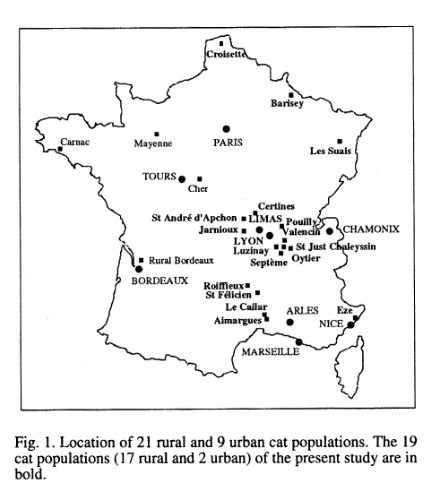
1 – Orange cats are more common in rural (less dense) as opposed to urban environments.
This demonstrates they they find better reproductive success in this particular social condition. Males tend to be more polygynous; they tend to have multiple mates, as opposed to females that tend to mate with only one male.
2- Orange cats are less common in areas with greater mortality risk
This can be a confirmation of their reckless, risky behavior that can even result in death. As opposed to other cat breeds/colors.
3- Orange cats show greater sexual dimorphism
Orange males weigh more than cats of other colors, and orange females weigh less than cats of other colors.
Researchers took this findings and come up with a theory – Orange cats enjoy better social status and therefore more reproductive success in rural areas. Whereas they struggle to keep up in urban areas. As Orange male cats tend to be more dominant socially speaking and also more aggressive. This combination leads both to more reproductive success and a higher mortality risk.
To conclude this study’s findings, We can say that although some interesting findings were made, this still doesn’t explain the orange cat stereotypes related to most of their personality traits. The one key takeaway is that orange cats seem to be more reckless compared to other cats. From there, we can only theorize. For example, their friendliness and trust in humans could be due to that higher social status they possess among other cats.

RELATED: Why Does My Cat Bite My Phone?
Are Orange Tabby Cats Any Different?
Orange tabby cats are often considered the craziest among orange cats. “Orange” is not a breed, and although we niche down if we talk about just orange tabby cats, it is still a broad generalization to make assumptions.
The term refers mostly to the stripes that cover their entire body. What we can remark about them is that they are mostly known for their colorful coats and unique patterns.
Regarding personality, they are inside the same bucket as most ginger cats as there are not any distinctive traits that separate both tabby and not tabby orange cats. Did you know that most orange tabby cats have an ‘M’ marking on their forehead?
The Truth About Orange Cat Behavior
Even though we reached interesting conclusions taking the available studies and research about orange cat behavior, the truth is that experts do not make any bold claims that justify the stereotypes seen in social media, nor people’s most common beliefs.
Pet Behavior scientist at Purina Annie Valuska sees the orange cat behavior as a cyclical phenomenon: “To make things even more complicated, owner perception and expectations can affect how they behave towards their cats, which in turn can affect the cat behavior.” This statement aligns with what we explained before. Of course, your cat can be playful and friendly, but even if you strongly believe that your orange cat has some traits unique to its color, remember what Dr. Valuska said: “There’s very little definitive evidence in the scientific literature that coat color is a reliable indicator of cat temperament.”

Debunked Stereotypes About Orange Cats
Orange cats only have one braincell
Come on! Seriously? I’ve seen this one so many times usually to express they have low intelligence or that they do not measure any of their actions (50% of truth on that last one). But if you know what we are talking about you know how smart cats are and ginger ones are no exception. If you aren’t sure about this, we invite you to check this article we wrote a few days ago where we explain how cats open the refrigerator door.
Orange cats tend to be friendlier
Again, there is no scientific evidence about this being true, and although surveys conclude that this is true we have to keep in mind that the result is likely the product of confirmation bias by orange cat owners (They say this is the case mostly because everyone agrees on the matter, but not necessarily because it is true).
Orange cats are crazy and reckless
This one we debunked but partially. As we saw in the 1985 research, orange cats were not common in places with greater mortality risk, which made us deduce that this correlates with the common belief that they are reckless and chaotic. However, remember that “orange cats” is not a breed, and it is a very wide generalization. In the end, it can just be a coincidence.
Key takeaways
To sum up, let’s compile the key takeaways:
- Most orange cats are male
- Orange cats thrive in rural environments
- There is no scientific proof that orange cats are friendlier toward humans, nor there is any about their supposed reckless behavior or their suspected lack of intelligence.
- There’s No correlation between a cat’s color and their behavior has ever been found and strongly supported by the scientific community.
- They are very cute and we love them
In my personal experience, I can confirm not everything said about orange cats is true, but I must confess that some memes around the internet have made me laugh and feel relatable!
I hope you found this article useful. If you did, feel free to spread the love 🙂
If you want to learn more about your cat’s behavior, check why does my cat chew on cardboard?
We are also introducing quizzes! Check our latest quiz: Does My Cat Have Separation Anxiety?


Very useful! Thank You:)